
Rethinking Detection Calibration: A Coordinate and Direction Perspective

1Dept. of AI, Chung-Ang University, Republic of Korea

2Dept. of Advanced Imaging, GSAIM, Chung-Ang University, Republic of Korea

3GS. of Virtual Convergence, Chung-Ang University, Republic of Korea

* Corresponding Author

European Conference on Computer Vision (ECCV) 2026

TL;DR: ReDC is a post-hoc calibration framework that provides coordinate-wise confidence scores while encoding the direction of localization errors relative to the ground truth.

Abstract

Overview figure for the abstract
Upload the teaser figure as
assets/images/teaser.png

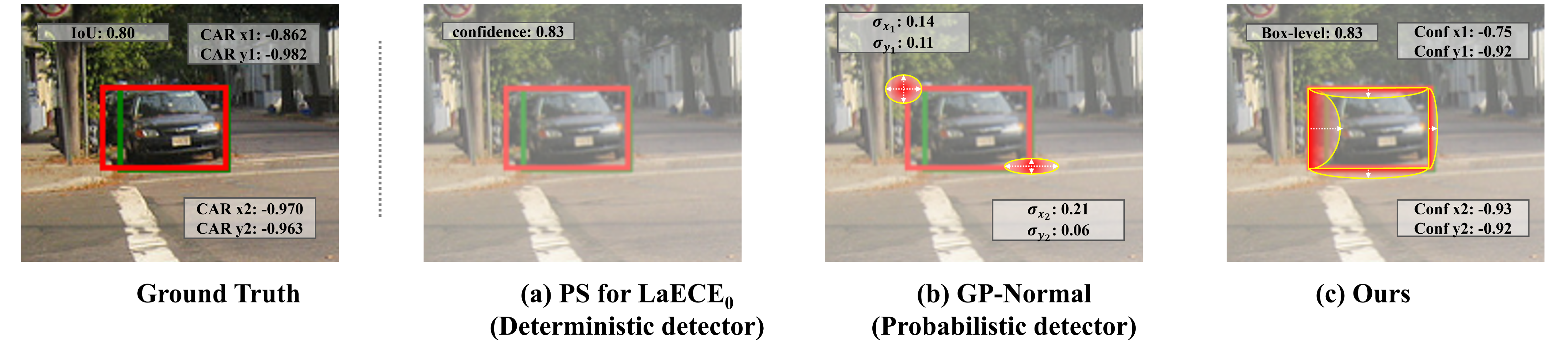
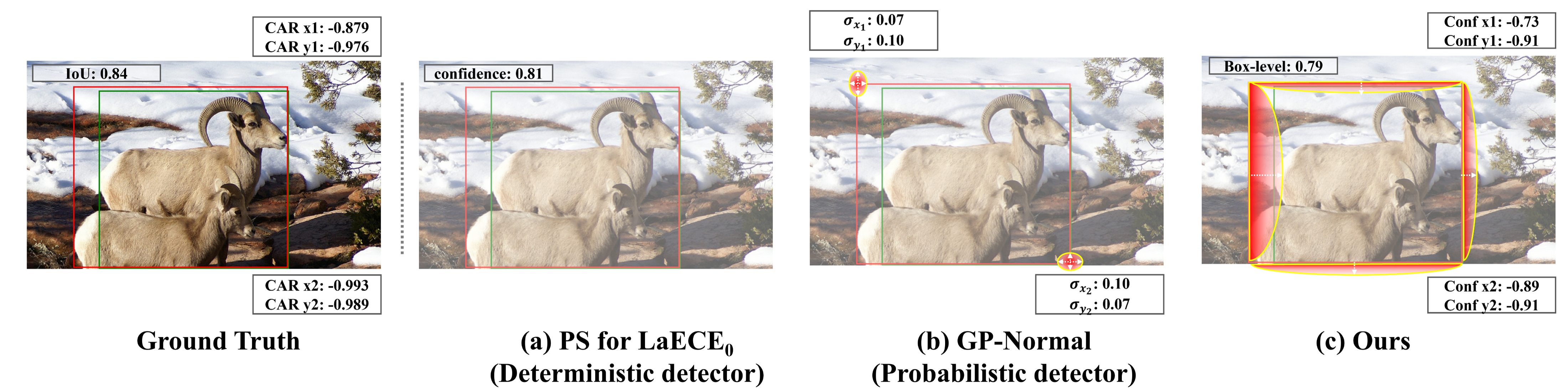
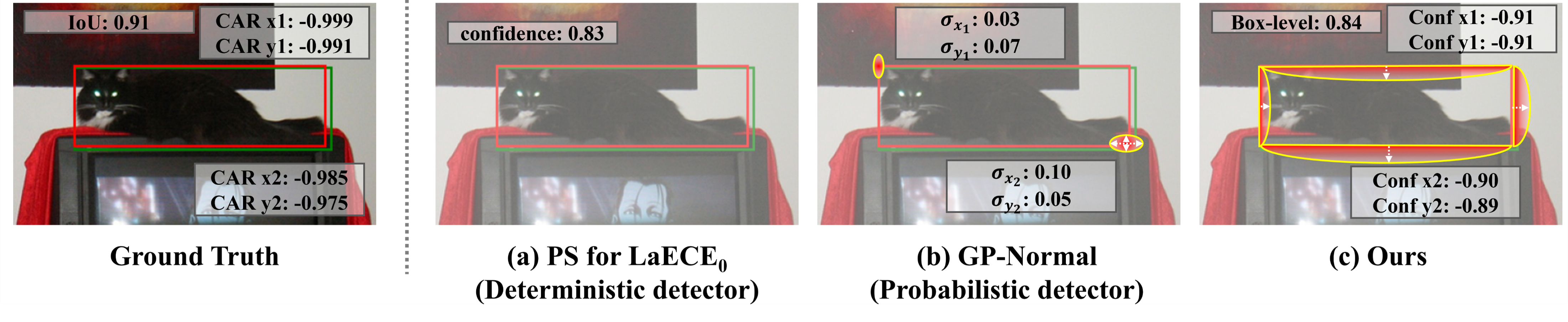
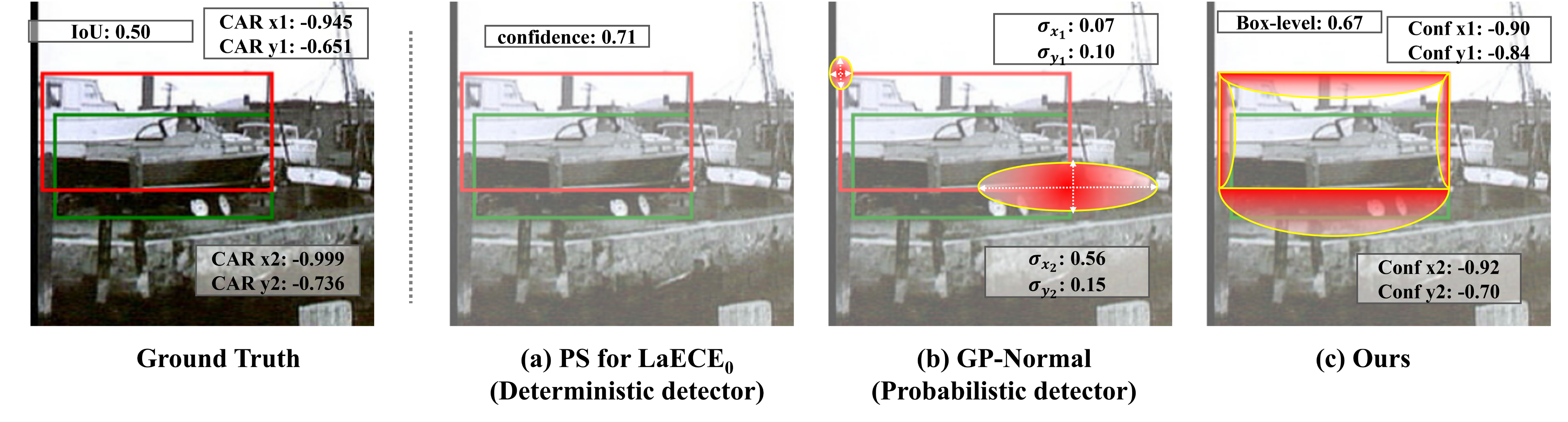
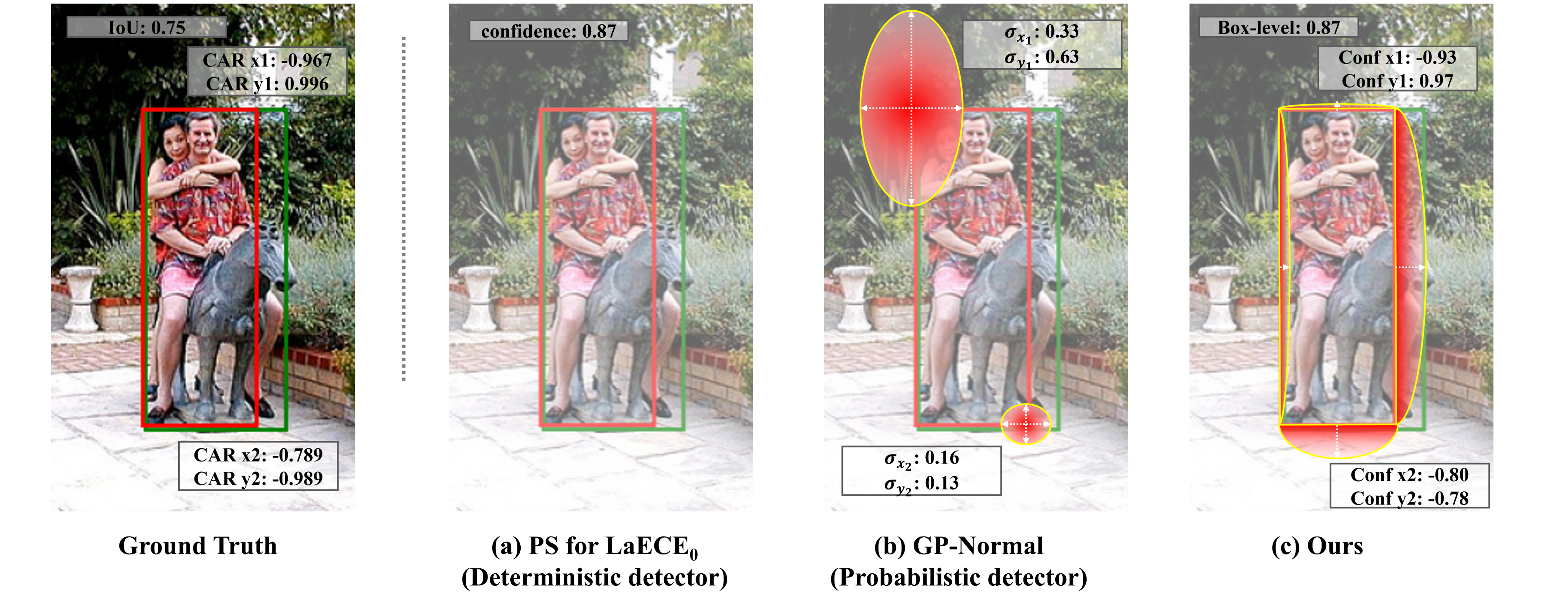
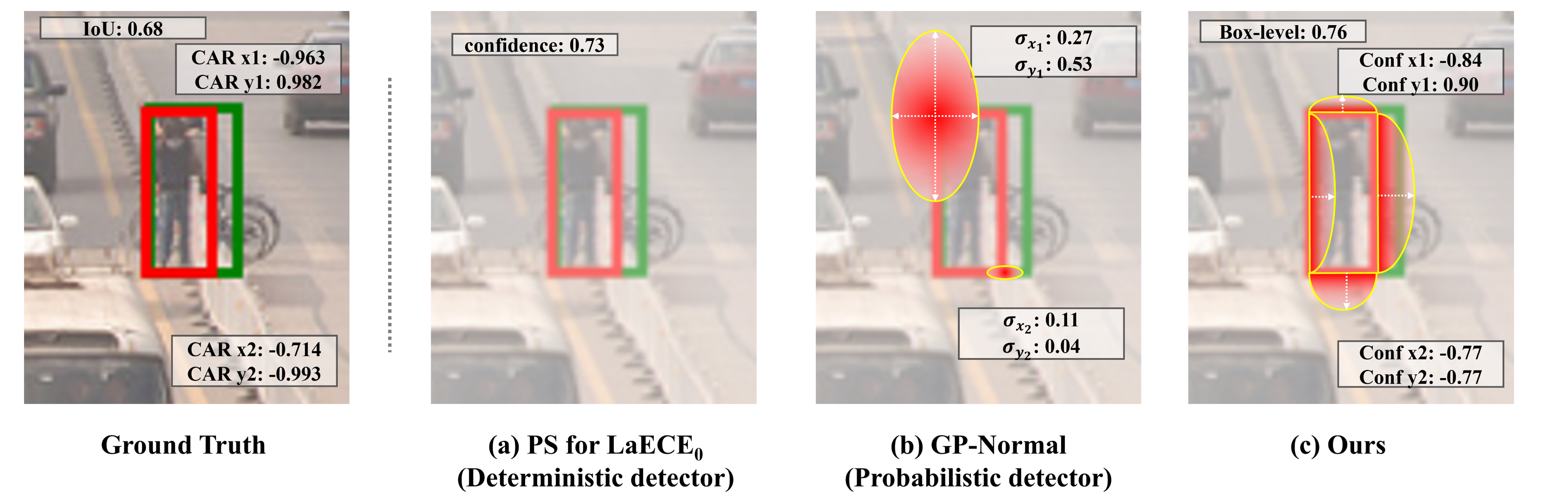
Deep learning-based object detectors often produce overconfident predictions, while most existing calibration methods focus on box-level localization and therefore cannot describe the accuracy of individual bounding-box coordinates. Probabilistic object detection methods model coordinate-wise uncertainty, but still collapse coordinate-level information into box-level confidence, fail to capture the direction of localization error, and require specialized probabilistic detectors.

To address these limitations, we propose Rethinking Detection Calibration (ReDC), a post-hoc framework that defines coordinate-wise alignment and deviation direction, re-encodes detection features into calibrated coordinate-level confidence scores, and estimates the direction of localization errors.

Experiments in both in-domain and out-of-domain settings show that ReDC represents coordinate-wise localization more precisely than prior methods while also supporting box-level localization calibration.

Method

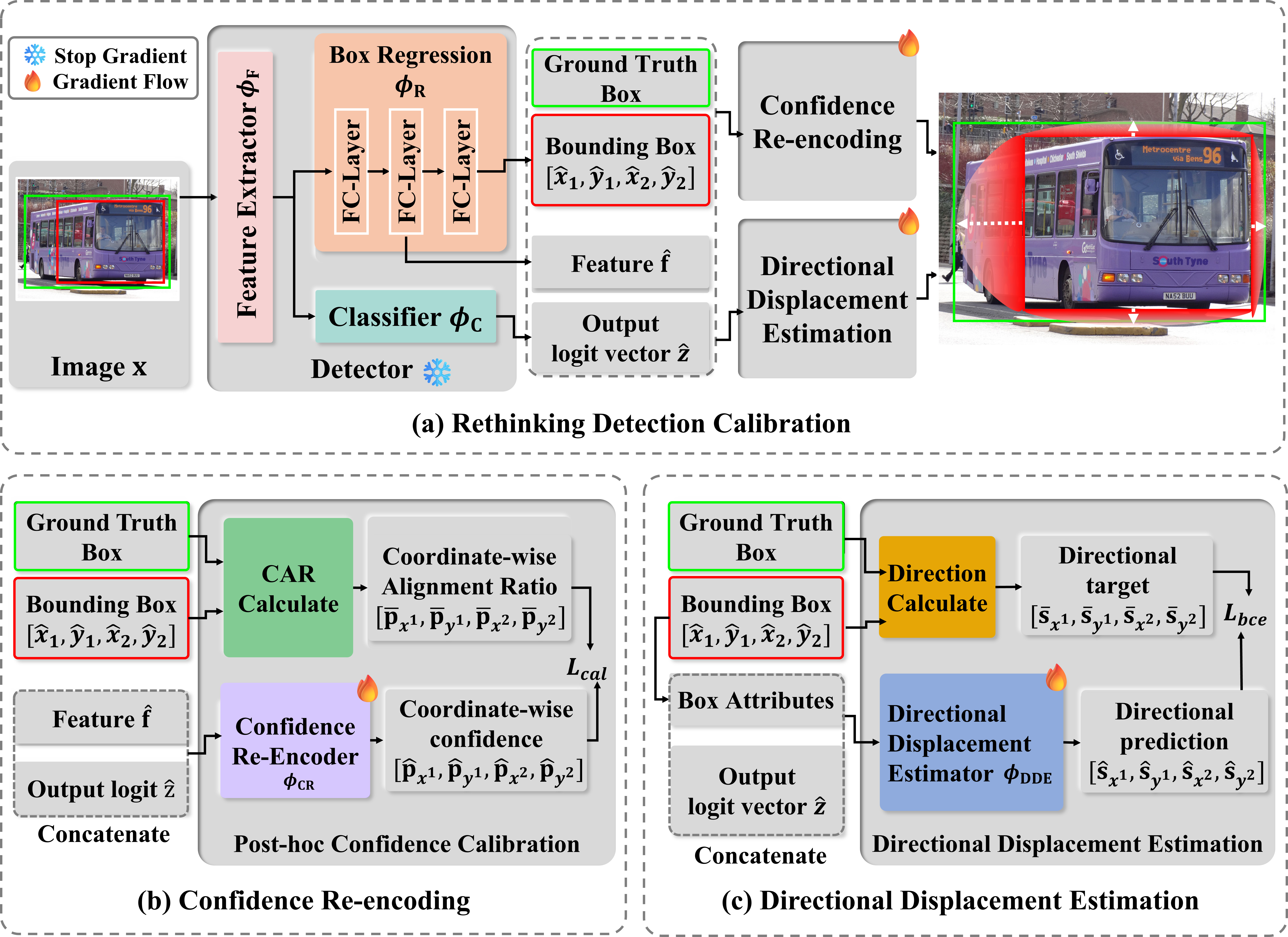
ReDC is a post-hoc calibration framework composed of a Confidence Re-encoder (CR), which converts detector outputs into calibrated coordinate-wise confidence scores, and a Directional Displacement Estimator (DDE), which predicts the direction of each coordinate deviation.

Overview of the ReDC framework
Upload the framework figure as
assets/images/framework.png
01

Coordinate-wise Alignment Ratio

Coordinate-wise Alignment Ratio (CAR) defines localization accuracy for each bounding-box coordinate using coordinate-wise differences and intersection lengths between predicted and ground-truth boxes.
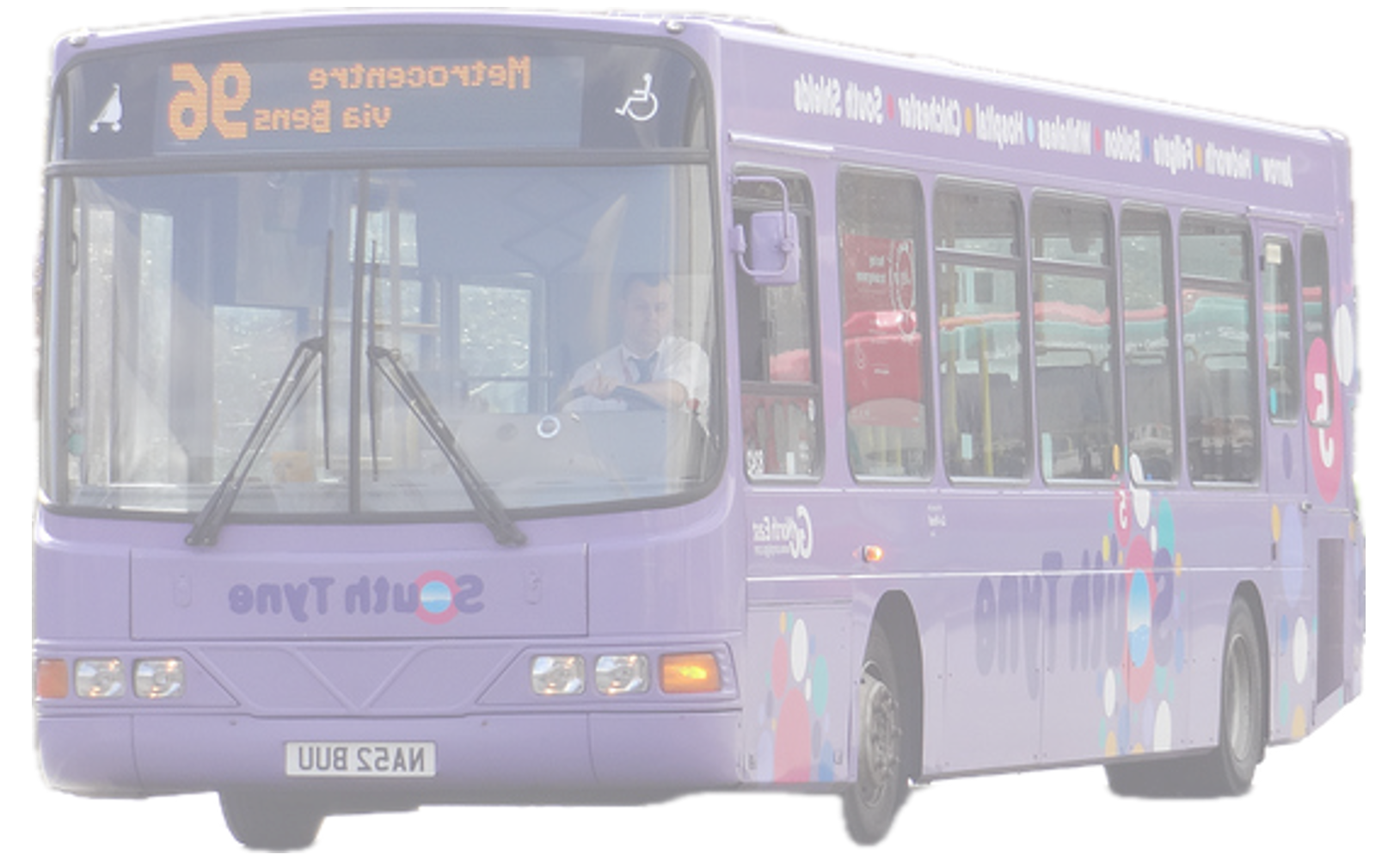
Bus image used for the interactive CAR illustration
Upload the bus image as
assets/images/car.png
GT
Prediction
\(\bar{p}_{x^1}\)
0.0
\(\bar{p}_{y^1}\)
0.0
\(\bar{p}_{x^2}\)
0.0
\(\bar{p}_{y^2}\)
0.0
Click the first corner
\[ \bar{p}_{x^l} := \frac{\mathrm{inter}_{w}}{\mathrm{dist}_{x^l}+\mathrm{inter}_{w}}, \quad \bar{p}_{y^l} := \frac{\mathrm{inter}_{h}}{\mathrm{dist}_{y^l}+\mathrm{inter}_{h}}, \qquad l\in\{1,2\}. \]
02

Confidence Re-encoding

Confidence Re-encoding (CR) combines detector output logits with bounding-box features to produce four confidence scores calibrated for the localization accuracy of individual coordinates.

\[ \mathbb{E}_{\hat{b}\in B(\hat{p}_t)} \left[\bar{p}_t\right] = \hat{p}_t, \qquad \hat{p}_t\in[0,1], \quad t\in\{x^1,y^1,x^2,y^2\}. \]
\[ \hat{\mathbf{p}}_i = \left( \hat{p}_{(x^1,i)}, \hat{p}_{(y^1,i)}, \hat{p}_{(x^2,i)}, \hat{p}_{(y^2,i)} \right) = \sigma\!\left( \frac{\hat{\mathbf{z}}_i} {\phi_{\mathrm{CR}}(\hat{\mathbf{f}}_i)} + \beta_t \right), \quad t\in\{x^1,y^1,x^2,y^2\}. \]

Here, \(B(\hat{p}_t)\) denotes predictions sharing the same coordinate-wise confidence, while \(\phi_{\mathrm{CR}}\) re-encodes the bounding-box representation \(\hat{\mathbf f}_i\).

03

Directional Displacement Estimation

The Directional Displacement Estimator (DDE) predicts whether each predicted coordinate is greater or smaller than its corresponding ground-truth coordinate using detector logits and geometric bounding-box attributes.

\[ \bar{s}_t = \begin{cases} +1, & \text{if } \hat{t}-t>0,\\ -1, & \text{otherwise}, \end{cases} \qquad t\in\{x^1,y^1,x^2,y^2\}. \]
\[ \hat{\mathbf{s}}_i = \left( \hat{s}_{(x^1,i)}, \hat{s}_{(y^1,i)}, \hat{s}_{(x^2,i)}, \hat{s}_{(y^2,i)} \right) = \phi_{\mathrm{DDE}}\!\left( \hat{\mathbf z}_i, \hat{\mathrm{cx}}_i, \hat{\mathrm{cy}}_i, \hat{\mathrm{w}}_i, \hat{\mathrm{h}}_i, \hat{A}_i, \hat{R}_i \right). \]
\[ \hat{s}_{(t,i)} = \begin{cases} +1, & \text{if } \sigma\!\left(\hat{z}^{c}_{s_{(t,i)}}\right) \ge \tau_t^c,\\ -1, & \text{otherwise}, \end{cases} \qquad t\in\{x^1,y^1,x^2,y^2\}. \]

DDE is trained with binary cross-entropy and converts its outputs into final coordinate directions using class-specific thresholds \(\tau_t^c\).

04

Box-level Calibration

ReDC combines coordinate-wise calibrated confidence scores with predicted displacement directions to approximate IoU. The approximated IoU is then calibrated against ground-truth IoU using isotonic regression or Platt scaling, providing both coordinate- level and box-level calibrated confidence scores.

Results

Quantitative Comparison

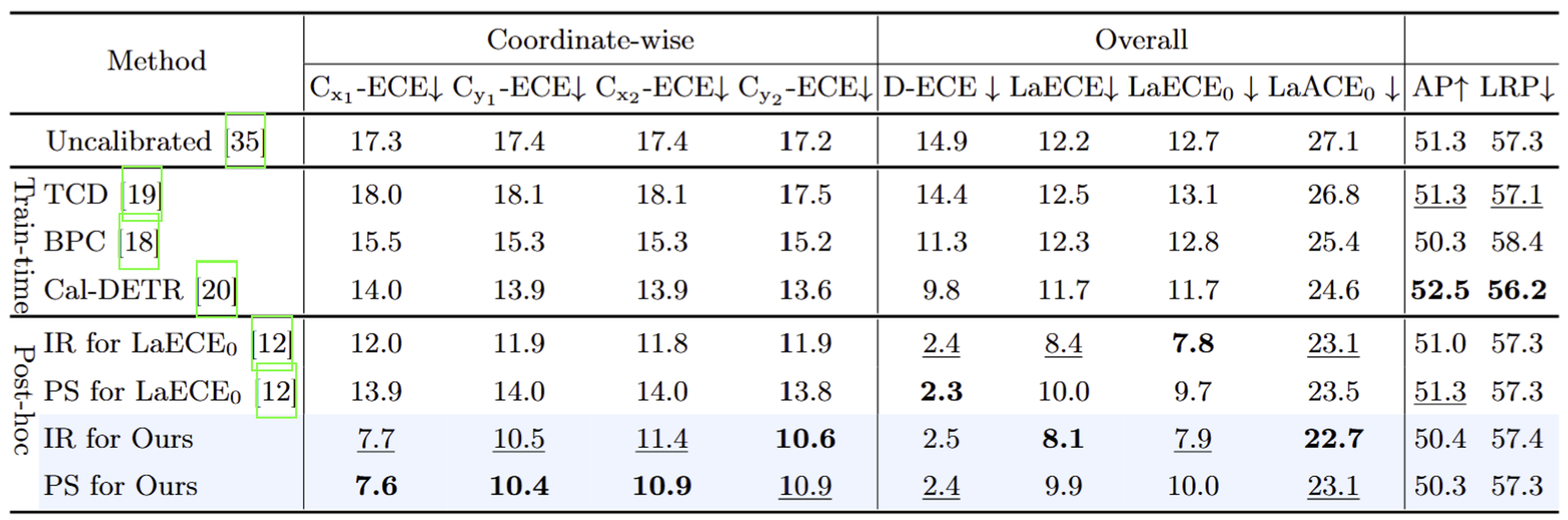
Extensive experiments on COCO and Cityscapes, under both in-domain and domain-shift settings, show that ReDC consistently outperforms existing methods in coordinate-wise calibration while remaining competitive in box-level calibration across diverse detector architectures.

Quantitative results on COCO
Upload
assets/images/results/quantitative/coco.png
COCO

Qualitative Comparison

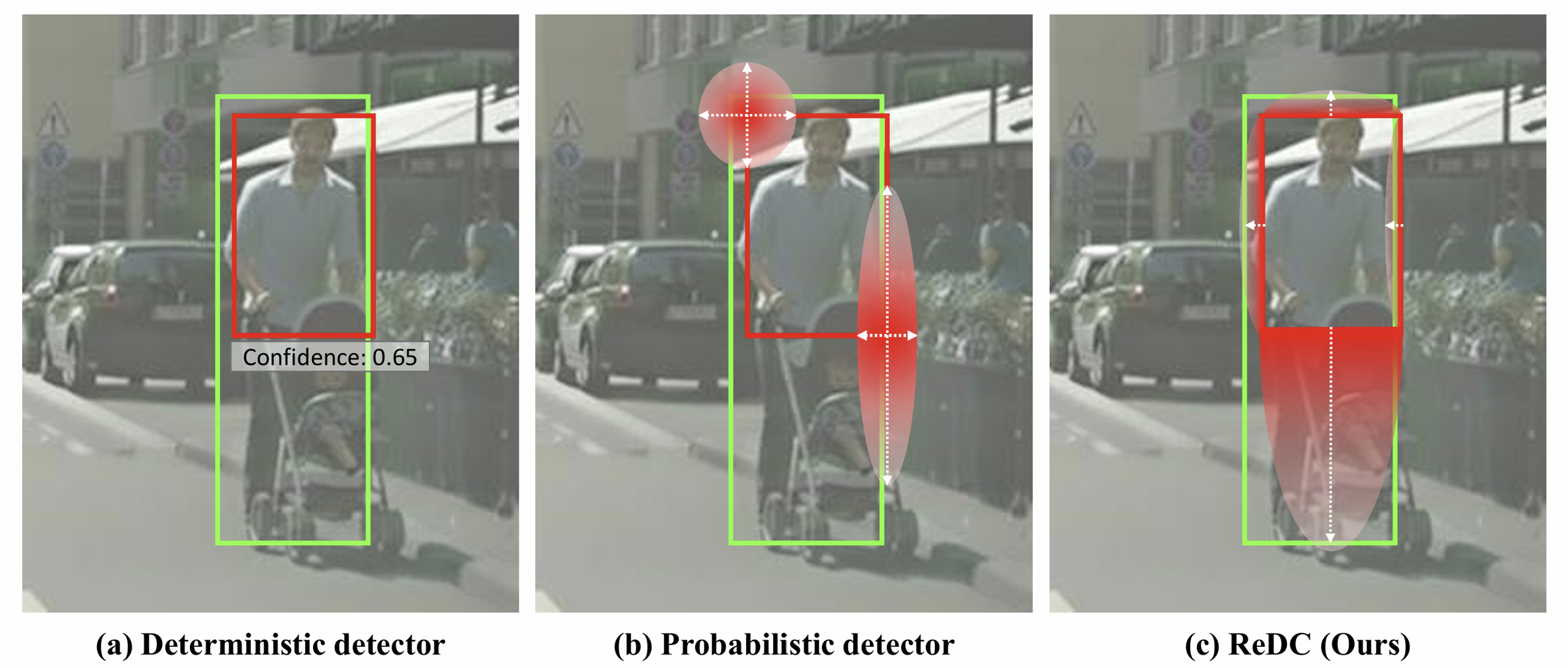
(a) Deterministic detectors typically assign a single confidence score to the entire bounding box, which cannot reveal which coordinates are misaligned. (b) Probabilistic detectors capture local uncertainty, but symmetric distributions often fail to represent the direction and magnitude of coordinate-wise deviation. (c) ReDC combines coordinate-wise calibrated confidence scores with predicted misalignment directions, enabling direction-aware estimation of coordinate accuracy.

BibTeX

The BibTeX entry will be updated once the ECCV 2026 proceedings are published.